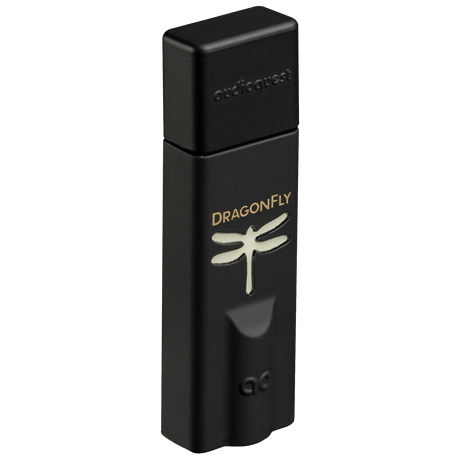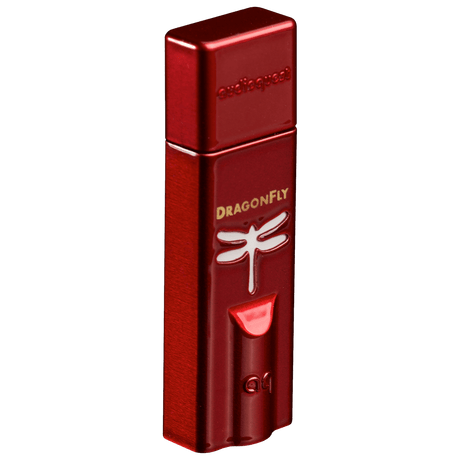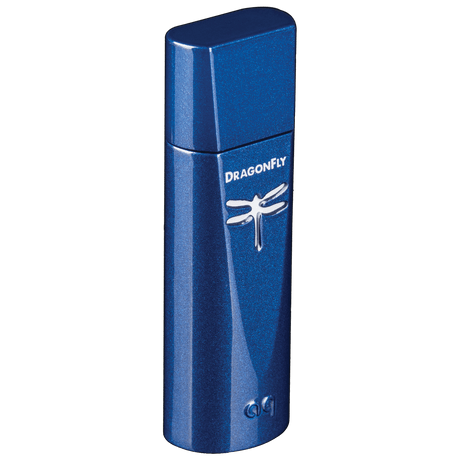
 To celebrate the launch of DragonFly Copper, the latest edition to AudioQuest's award-winning series of portable USB DACs, AudioQuest dealer, Home Automation Designs, got in touch with designer Gordon Rankin and Senior Director of Engineering Garth Powell to learn more about what makes Copper shine.
***
Home Automation Designs: DragonFlys Black and Red were released in 2016. DragonFly Cobalt followed three years later. Why did it take nearly seven years to release a new model?
Gordon Rankin: Well, we had expected the product to arrive much sooner. We had been in development for some time when COVID hit and everything kind of halted, creating a pretty big gap in development.
When we started again, the plan for the next-generation DragonFly was very specifically focused on creating a more powerful version of what already existed. The project was codenamed “Ruby,” and, like Black, Red, and Cobalt, it would be an MQA renderer, which significantly impacted many of the project’s design criteria.
But then MQA pretty much went away, and the Ukraine war started, both of which altered our course. Ukraine supplies a huge number of natural resources that were used in discrete components in all the DFs, which are now unavailable, so we had to source new parts and reconsider our design goals and development strategy.
HAD: How did the streaming industry’s move away from MQA impact DragonFly Copper’s development process?
GR: A USB DAC basically takes byte frames as they come, then converts that data to a 32-bit buffer that is next converted to I2S and finally sent to the DAC chip.
With MQA, you couldn’t just convert — you had to process each frame received by the Host to determine whether it’s MQA or just standard PCM. If MQA was identified, then you had DSP responsibilities to process the data. That requires a processor with more guts, which then means more power drawn from the Host (over USB).
Removing MQA from the product-development mandate opened new possibilities for the parts we could use and how they could be applied.
HAD: From a technological standpoint, what makes DragonFly Copper a meaningful success over previous models? Is it new parts, new implementations of old parts, or some combination of both?
GR: It was pretty much a restart.
Removing the Fly’s ability to render MQA meant there would be less DSP work in the processor, so we could use one that required less power.
One of the biggest requests we received from customers was for more headphone power, so we approached ESS and they delivered the ES9218 — an integrated DAC/headphone combo. This gave us two times the headphone power of any previous DragonFly and lots of nice digital filters that we used in Cobalt.
But the big-time component was finding capacitors that were exceptional for the job. You can read data sheets all day long but to get things in a place that really exceeded Cobalt required concentrated testing and significant changes in board layout.
 HAD: DragonFly Copper features a beautiful copper-plated case informed by the RF-draining barrels of AudioQuest’s Mythical Creature interconnects. In Copper’s development process, which came first — the model name or the copper-plated case?
Garth Powell: The case.
We knew from the development of our Mythical Creature interconnects that a linear material that’s highly conductive at radio frequencies, such as a thick, dipped-process copper plate, would afford the DragonFly circuits superior noise dissipation. The direct-plated copper is far more effective at draining away induced radio-frequency signals than polymer, brass, zinc, or aluminum.
It’s a small detail, but one that is quite audible. And, of course, once the casework was settled, the model name became obvious.
HAD: DragonFly Cobalt could not be unconditionally recommended for use with AudioQuest’s JitterBug USB filter. Why was this and what makes Copper different?
GR: Cobalt contains some of the filtering technology featured in JitterBug, and it’s generally inadvisable to use two filters in series, so partnering Cobalt with JitterBug didn’t always produce desirable results.
That isn’t the case with Copper. (Alright, pun intended.)
Copper is the quietest DragonFly we’ve ever produced, but even more noise can be rejected with the addition of a JitterBug.
 This photo, captured at Mirac Tabtronics in Lynchburg, Ohio, by DragonFly designer Gordon Rankin, reveals a cluster of DragonFly awaiting their namesake casework.
***
HAD: Previous DragonFly models came equipped with a removable USB cap and offered various DragonTail USB extender cables as available options, but Copper comes without a cap and ships with its DragonTail USB-C adaptor attached. Why?
GR: I think USB-C was set to become a global standard as defined by the European Union as far back as 2015. That of course didn’t happen, but it has pretty much been a staple for several years. The big problem of course is the dimensions of USB-C and the proximity to other ports. You really need a cable of some kind. There are also a lot of streamers and computers that still have USB-A connectors.
From a practical, real-world perspective, DragonFly owners often lost their units’ caps. And, as AudioQuest is always looking for ways to provide more for less, we figured doing away with the cap and having the DragonTail preinstalled was a simple way to give our customers what they really need while saving a small expense.
For those who want to connect their DragonFlys to a USB-A device, removing the DragonTail is a simple step — and the DragonTail remains a far more valuable, functional accessory.
HAD: DragonFly forgoes a volume knob, buttons, touchscreen, or other method to manipulate volume level, choosing instead for volume to be controlled by the source device. Why?
GR: First, DragonFly negotiates with the Host, informing it that it has its own internal volume control. Giving control to DragonFly means the Host will deliver bit-true music to the DragonFly.
Sure, you could add volume control knobs and touchscreens, but those are both easily broken and require more power.
HAD: With so many competing units offering the ability to play up to 32-bit/384kHz resolution, why do you continue to limit DragonFly’s resolution to 24/96?
GR: Simple: USB DACs that use High Speed USB draw between two to 10 times more power than going with Full Speed USB, which tops out at 24/96.
Just because you can do something, doesn’t mean you should. What happens when a USB DAC is processing 32/384 frames? Usually, the result is barely breaking 16/44.1 specifications. The current draw, the signal-to-noise ratio, the processing, the heat… it’s all throwing everything into the toilet.
Plus, a significant number of our customers use DragonFly with their mobile phones. Compared to a DAC running High Speed USB and 32/384 processing, Copper will not affect the phone’s battery much at all.
 HAD: Who do you see as the ideal customer for DragonFly Copper?
GR: The greatest joy about working with AudioQuest and DragonFly is being in an airport or on a plane or wherever and seeing someone using one of the DragonFlys that I helped create.
The discussion around DragonFly’s versatility — the ways and places it can be used — is just amazing. Since I also design pro-audio equipment and work with musicians, I often get to share DragonFly with people in those worlds, and they are stunned by the output capabilities of the DragonFly line.
Most of these people have a lot of downtime and they say they use DragonFly while watching movies on the tour bus and as a production tool, working on and evaluating their music.
DragonFly takes any Host with a USB port to the next level, regardless of how it’s used, which makes it valuable to a wide range of listeners. I just love that.
***
Serving Alberta and Ontario, Home Automation Designs is dedicated to delivering exceptional services that stand the test of time. They believe a home should be more than a place to live — it should reflect a client's lifestyle, values, and dreams. For more information, visit the Home Automation Designs website, call 1 (866) 423-1919, or email support@homeautomationdesigns.com.