




DragonFly Copper
USB DAC · Headphone Amp · Preamp
Meet your new best friend — the perfect travel partner, office buddy, homebody, and everyday companion: DragonFly Copper.
DragonFly is a portable digital-to-analog converter (DAC) designed to produce cleaner, clearer, more naturally beautiful sound from any mobile device or computer.
But why would anyone need a digital-to-analog converter?
The DAC in your pocket isn't designed for music
Every smartphone, laptop, tablet, Bluetooth speaker, car stereo, CD player — basically any piece of digital electronics that produces sound — already contains a DAC. But the DACs in most of these devices are designed to produce sound effects and alerts, not fully expressed music. So even when the technical capabilities look impressive, the nuance that makes music so engaging is missing.
Enter DragonFly. When connected to any device that supports USB Audio Class output, DragonFly bypasses the source component's internal audio circuitry to take control of the digital-to-analog conversion, unlocking a more immersive and emotionally compelling experience at home, at work, or on the go.

Beautiful Music Everywhere

Your music, your device, your way
DragonFly comes with AudioQuest's DragonTail USB-C adaptor, which allows the DAC to be quickly and securely connected to computers, tablets, and smartphones with USB-C outputs. For USB-A devices, simply remove the DragonTail to reveal DragonFly's USB-A plug. At its opposite end, DragonFly's 3.5mm output jack allows for direct connection to headphones or, via 3.5mm audio cable, to powered speakers and complete audio systems.
Plug into an Apple or Windows® computer or connect to an iOS® or Android mobile device. Stream high-res audio from Tidal or Qobuz. Experience improved sound quality from movies, videos, and games. Enjoy beautiful music everywhere.
Music First
DragonFly Copper uses a highly sophisticated 32-bit ESS SABRE DAC — a low-power device with an integrated headphone amplifier specifically designed for power-sensitive audiophile-grade applications. While this specialized part supports up to 384kHz PCM and DSD256 audio data, we've intentionally limited DragonFly's native data-processing abilities to 24-bit/96kHz.
Why limit the processing to 24-bit/96kHz?
First and foremost, it sounds better. More processing requires more power, and more power inevitably creates more switching noise throughout the system. In countless listening tests over many years, we've consistently found that greater power consumption leads to relatively poor sound quality while greater power conservation leads to improved sound quality.
This also makes using DragonFly nearly as natural and intuitive as the act of enjoying music itself. Fully compatible with all PCs without downloading drivers or learning a clunky interface, DragonFly is designed to play with the devices you own and to honor the music you love.
LED Playback Indicator
DragonFly Copper's dragonfly emblem changes color to indicate playback status and the sampling rate of the file being played.
| LED Color | Status / Sample Rate |
|---|---|
| Red | Standby |
| Green | 44.1 kHz |
| Blue | 48 kHz |
| Yellow | 88.2 kHz |
| Light Blue | 96 kHz |
Let's Talk About Sample Rates
DragonFly can play basically everything and make it all sound better. What about files beyond DragonFly's 24/96 limitation?
What if you want to play files at higher sample rates?
No problem! For files with higher sample rates, your computer or mobile device, in tandem with its playback software, will resample the data to a compatible resolution. For the best performance with sampling rates above DragonFly's 96kHz ceiling, files should be played at a rate mathematically related to their native resolution. For instance, a 192kHz file should be played at 96kHz (2 × 96,000 = 192,000).
Good old compact discs have a sampling frequency of 44.1kHz. Compressed MP3 and AAC music files are typically encoded at 128kbps, 256kbps, or 320kbps and most often reconstructed as 44.1kHz files. For this reason, when used with a computer, DragonFly will often produce the best results when the computer is set to output 44.1kHz.
Quick guide
Listening to music? Default to 44.1kHz (green LED) or 88.2kHz (yellow LED).
Watching movies? Try 48kHz (blue) or 96kHz (light blue). Your operating system handles the rest automatically.
Many music-playback applications — including Roon, BitPerfect, Foobar, JRiver, Audirvana, Decibel, and Amarra — will automatically set the sample rate of DragonFly to that of the file being played, eliminating the need for manual setting entirely.
Evolution Never Stops: Good, Better, Bloody Hell!
A lineage of firsts
Like all AudioQuest products, DragonFly has benefited from gradual refinements made possible by better parts, better materials, and our own insatiable desire for better sound. Of the original DragonFly, released in 2012, the late, great audio journalist Art Dudley wrote for Stereophile: "Perhaps best of all, the DragonFly is fun: It's a thumb in the eye of those tea-pinky tyrants who would tell the rest of us what is and is not high end."
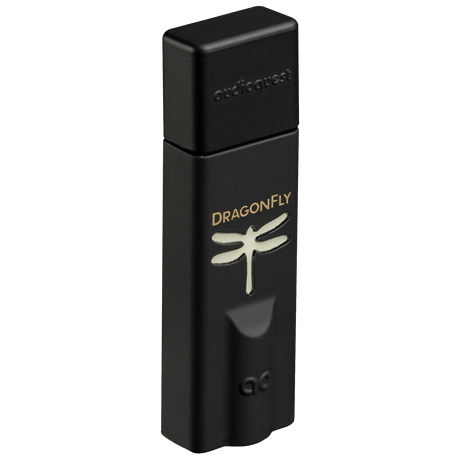
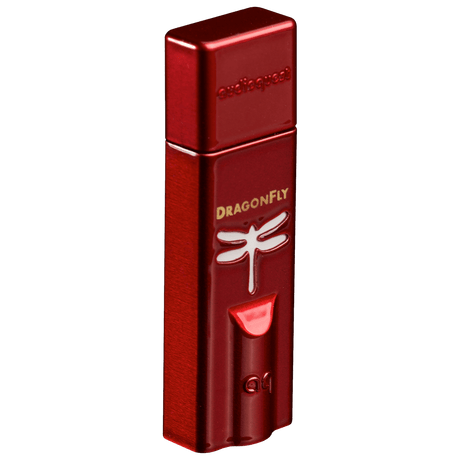
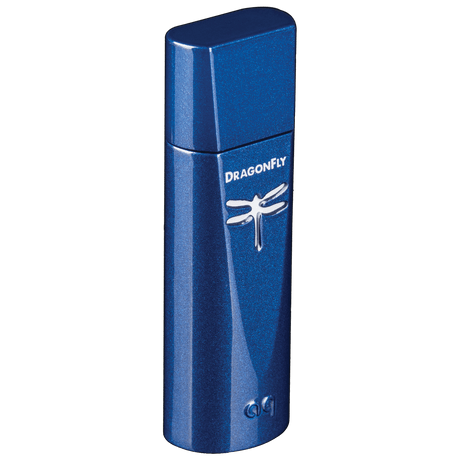
DragonFlys Black and Red answered the call of music lovers everywhere for DragonFlys that could be used with Apple iOS and Android devices — proving that convenience and performance were no longer mutually exclusive. DragonFly Cobalt followed with a more advanced processor, microcontroller, and RF noise filtering, delivering even greater clarity, dynamics, and finesse.

Whenever there are three products in a line, there's a temptation to class them, 'good, better, best!' but in this case, it's, 'good, better, bloody hell!'— Alan Sircom, HiFi+
DragonFly Cobalt received enthusiastic recommendations from Rolling Stone and Men's Health while earning glowing praise from Stereophile, The Absolute Sound, Twittering Machines, Part-Time Audiophile, SoundStage, Audiophile Style, and many more of the world's leading hi-fi publications.
Darko.Audio's John Darko, among the earliest reviewers to put DragonFly thoroughly through its paces, produced an outstanding video detailing his experience with DragonFly Cobalt:
I can't think of another DAC that let alone sounds this good for its price point but also can be used with computers and with smartphones. I cannot enthuse about this device enough. It's bloody amazing.— John Darko, Darko.Audio
Two years after Darko's positive experience with Cobalt, his esteemed colleague Jana Dagadagan travelled to DragonFly's manufacturing facility, Mirac Tabtronics, in Lynchburg, Ohio, for a behind-the-scenes look at the Cobalt manufacturing process:
Hundreds of Thousands Served

Made in America, loved worldwide
The overall result of all this refinement and fussing is immeasurably greater musical immersion, discovery, and enjoyment — all at an unrivaled price-to-performance ratio. DragonFly Copper today has the same $250 price tag that made the original DragonFly such a bargain back in 2012 — only, when adjusted for inflation, today's $250 would have been about $175 then.
In total, more than 300,000 discriminating listeners have enjoyed beautiful music at home and on the go with DragonFly. To this day, board production, assembly, and packing of DragonFly continues in the trusted, experienced hands of the good folks at Mirac in Lynchburg, Ohio.
Inside DragonFly
All iterations of DragonFly have benefited from DragonFly designer Gordon Rankin's monoClock® technology and his StreamLength® asynchronous USB code. With monoClock® technology, a single ultra-low-jitter clock generated from the DAC chip runs the headphone amplifier as well as all microcontroller functionalities, enabling greater resolution and clarity than DACs that employ multiple clocks.
StreamLength® asynchronous USB code ensures improved delivery of the audio samples to the DAC chip. It produces low jitter, low resource load, minimal packet errors, world-class audio playback, and reliable connectivity — and requires no additional drivers.
More Than Just a Pretty Penny
The most capable DragonFly ever made
The new ESS DAC/headphone amp allowed for the implementation of a slightly smaller processor, which reduced power usage by about 25% and significantly improved overall supply-chain efficiency. Gordon Rankin then did what he does best — he optimized the parts for performance, eventually reducing distortion to a level well below that of Cobalt.
Drawing 25% less current and delivering two times as much output power as any previous DragonFly, Copper is the most efficient and versatile DragonFly ever produced. Its shiny copper case isn't merely gorgeous — like every other aspect of the design, it's been implemented for improved RF noise-dissipation, informed and inspired by the RF-draining barrels of AudioQuest's Mythical Creatures interconnects.

Copper is a home run! Compared to Cobalt, it has more gain, more bottom-end grip, more micro-dynamic expression, and more resolution.— Garth Powell, Senior Director of Engineering, AudioQuest
DragonFly's Best Friends
For even lower noise and better overall performance, try DragonFly Copper in series and in parallel with AudioQuest's JitterBug USB Data & Power Noise Filter. With its Dual-Discrete Noise-Dissipation circuitry, JitterBug reduces all forms of internal noise in both the sending and receiving electronics.
Use AudioQuest's 3.5mm-to-3.5mm or 3.5mm-to-RCA interconnects to connect DragonFly to powered speakers or complete audio systems. When using DragonFly with USB-A devices, add AudioQuest's DragonTail USB-A extender cable to aid flexibility, allowing DragonFly to more easily and safely fit next to other occupied computer ports.
To stay up to date on the latest DragonFly news, register your product at audioquest.com.


