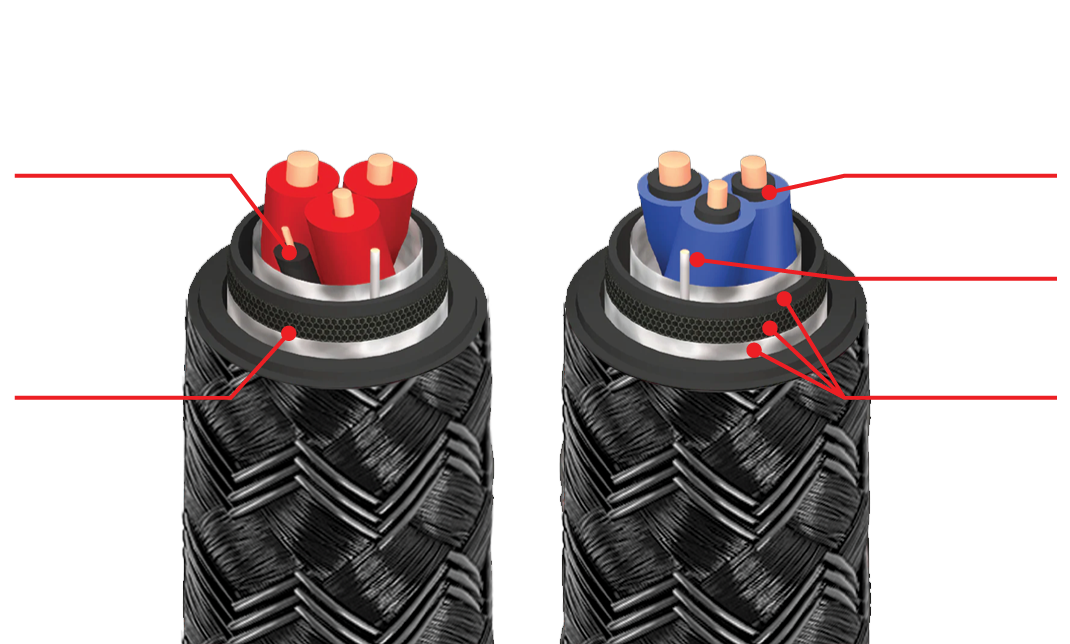
Slightly smaller than Brave Heart (11.6mm OD vs Brave Heart's 14.1mm OD per polarity) and boasting the same friendly construction that places positive and negative sides in discrete housings, Lone Ranger offers a remarkable sonic improvement over its predecessor characterized by eye-opening resolution and presence, realistic dynamic ease, and a surprisingly authoritative overall presentation.
Like its larger sibling, Lone Ranger meaningfully blurs the line between Folk Hero and Mythical-level sound quality. How is this achieved? Lone Ranger features many of the same upgrades that make Brave Heart such a thrilling success.
- Almost one-third more PSC+ Copper for lower impedance, smoother frequency response (regardless of speaker impedance curve), and a more muscular presentation.
- Superior polypropylene dielectric (insulation) linearizes and expands the bandwidth of noise-dissipation.
- Optimized dielectric reduces out-of-focus, harsh-sounding distortion due to distributed capacitance.
- Thicker Carbon-Loaded PVC, added Graphene layer, and 4% silver shield drain wires further improve RF-Noise Dissipation.
Permanent Molecular Optimization (PMO) does not replace the important aural benefit of playing music over extended periods of time. Music (modulated AC signal) slightly stresses the dielectric and connection interfaces, significantly benefitting cable performance.
PMO is a controlled extreme stressing of the materials — a near-death experience for them — that significantly and permanently (unlike running-in) helps the cable get out of the music's way.
All this is complemented by several important tried-and-true AudioQuest design elements. These include:
- Solid conductors prevent strand interaction.
- Direction-controlled conductors efficiently drain RF noise away from the vulnerable amplifier circuitry — toward where it will do the least or no harm.
- ZERO-Tech eliminates characteristic-impedance mismatches between the cable and the attached source and load, allowing power to flow seemingly unencumbered, presenting sound and music with remarkable ease.
- The constant DC potential (in contrast with running-in and PMO’s AC stressing) of AudioQuest’s 72v Dielectric-Bias System polarizes the dielectric (insulation), significantly reducing Dielectric-Noise (energy stored in the dielectric being released out of time and at other frequencies). DBS also linearizes (makes more consistent across a wide band) Radio-Frequency Noise-Dissipation.
- There is no metal in the cable dressings or plug barrels, which would reradiate and capacitive-couple RF-Noise into the cable. Cold-welded gas-tight connections are made to Red Copper spades or bananas.
And keep eyes and ears open for BigFoot — BigFoot BASS cable with Radio-Frequency Noise-Dissipation (RF/ND) is the Bass cable complement to Lone Ranger. As wonderful as Brave Heart is for Full-Range loudspeakers, when the speakers offer the capability to BiWire, Lone Ranger on Treble and BigFoot on Bass is the definitive answer to two very important questions:
- How do I BiWire in the Brave Heart price range?
- Is BiWiring worthwhile?